# AI-native intelligence can change how pharma makes strategic decisions
Stefano Pacifico on how AI can alter pharmaceutical intelligence, the human role, and why connected evidence and specialist agents still matter.
By Stefano Pacifico — Co-founder and CEO, Epistemic AI
Published: 2026-10-29T14:58:25-04:00
Canonical: https://epistemic.ai/insights/ai-native-intelligence-pharma-strategic-decisions/
Executive summary
I think we are approaching a rather important change in pharmaceutical intelligence. AI makes analyses faster and less expensive, and gives us the ability to keep them current. That changes which questions companies can afford to investigate before they make a decision. But it does not happen by giving a scientist a chat window and expecting the rest to take care of itself.
---
I think our expectations of software have changed dramatically. We increasingly
expect it to do our work, not just help us do it. We want it to be fast,
correct, and good enough to share with our colleagues without spending hours
fixing it. Ideally, we want it to read our minds.
And AI makes that expectation seem reasonable. But anyone who has spent a
serious afternoon working with ChatGPT or Claude on a complex question knows
that there is still a large difference between a good first answer and a
complete piece of work. A convincing answer can be missing important evidence,
sometimes in ways that are hard to predict. In pharma, where a small nuance can
change the conclusion, that is a serious problem.
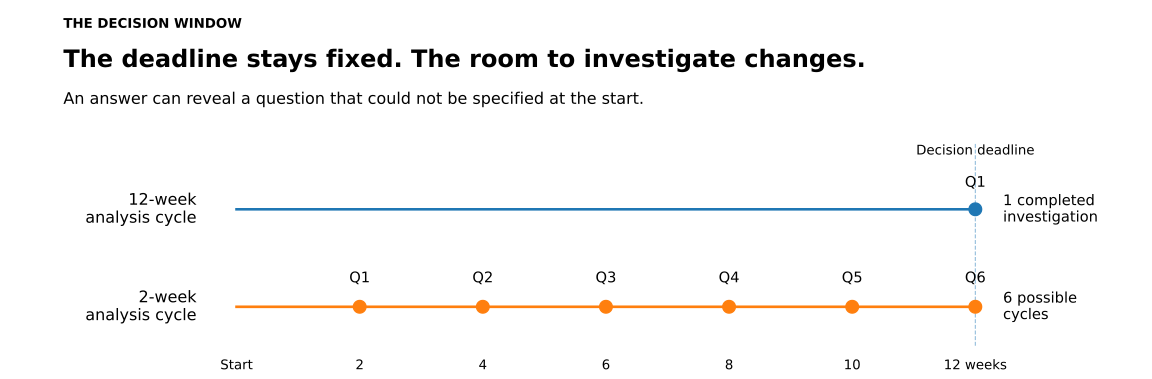
At Epistemic AI, we have seen work that used to take roughly three months move
to two weeks across successive engagements, with delivery costs about a third of
what they used to be. The work is also kept current by agents and our
scientists. I mention these numbers because I believe their consequence is much
more interesting than the productivity gain itself: they change which
investigations are feasible while the decision is still open.
1. Speed changes which questions a company has time to investigate
A pharmaceutical client asked us to characterize the white space in a particular
indication. That sounds like one question, but the white space was large and
therefore quite difficult to describe in a useful way.
Our initial analysis showed that what looked like one big white space was
actually many smaller ones. Once the client could see that structure, they were
able to focus on a particular opportunity that they would otherwise have
struggled to identify in time.
I want to be precise about this. There was nothing intellectually impossible
about the work. A good consulting team could have done it. The problem was the
time and effort it would have required, compared with the calendar for the
decision.
And that is, I think, the most important consequence of speed. The first
question is often not the right question, or at least not the last one. You
learn something, you ask the next question, and sometimes you discover something
you had not thought of at all. But if the first answer arrives three months
later, there may be no time left to do anything with it.
So one change I would suggest to pharma teams is to stop treating every
intelligence engagement as a report whose contents must be fully specified in
advance. Specify the decision and the questions you know, of course. But leave
time for the questions you do not yet know you should ask.
Faster analysis can leave time for questions revealed by the first answer.
2. Lower costs make exploration possible before committing to a course
The cost of intelligence has also shaped the way it is used. When an analysis is
expensive and takes a long time, you naturally become very selective. Often you
commission the work only when you already have a reasonably clear hypothesis and
need to confirm it.
There is nothing wrong with that. But it means a lot of potentially interesting
avenues never receive a serious look, not because the science is uninteresting,
but because investigating them is not economical.
Take a target product profile, or TPP: the description of what a drug will need
to look like to be successful. It is useful to have one early, because it forces
the team to understand the competition, the expected standard of care and the
attributes that will actually matter. Yet it can take months to develop a good
one, so companies cannot simply produce detailed TPPs for every candidate and
possible indication.
Now imagine being able to investigate preliminary TPPs across an entire
preclinical portfolio, then going into much greater depth on the most promising
possibilities. That would change not only the volume of analysis, but when and
how a company makes its choices.
That broader use across portfolios remains a prediction. What we have already
seen is the first step: once the cost and turnaround fall, clients begin to ask
questions that would not have been practical before.
3. Intelligence is much more useful when it does not go stale after delivery
There is another peculiar thing about intelligence reports. They begin to
depreciate as soon as they are delivered. A competitor publishes a clinical
result, a trial is amended, an asset disappears from a pipeline, or a new deal
changes the landscape. What was a perfectly good analysis last Monday may need
to be revisited on Wednesday.
Historically the client either pays to update it or, more often, continues using
a report while knowing that parts of it are becoming stale. That is not a
particularly satisfactory way of working.
What I believe is changing is the nature of the product itself. At Epistemic AI
our agents continuously monitor the evidence behind the analyses our clients
receive. When something relevant changes, they alert our team and propose
modifications. Our scientists examine them, and only after formal approval is
the online analysis updated.
This is important: continuous monitoring does not mean letting an AI rewrite
conclusions without anyone checking. It means you no longer need to assemble a
new team and start from scratch every time the world moves. The intelligence can
evolve, and confidence in an earlier conclusion can go up or down as the
evidence changes.
It also changes the relationship with the client. Instead of delivering a report
and disappearing, we can continue the conversation as the scientific and
competitive landscape evolves.
4. As agents do more information work, scientists can focus on what requires judgment
I have heard the concern that if agents do more of the analytical work, the
scientists will become less important. I think the opposite is true, provided we
use their time differently.
An extraordinary amount of work in traditional intelligence services goes into
finding papers, navigating databases, checking which asset belongs to which
company, reconciling terminology and preparing the material. These tasks are
necessary, and they can absorb weeks of time. They are also exactly where
machines can help enormously.
What scientists contribute is something else. First, they recognize when the
agents have missed a nuance of what the client really wants. Second, like a good
manager of a team, they keep the work focused and avoid spending time on
directions that are unlikely to be useful. Third, they make sure the results can
sustain rather harsh criticism and scrutiny. And finally, they often identify
new questions to bring back to the client.
In other words, scientific experts do not sit at the end of the process merely
to proofread a machine-generated report. They participate in deciding what
should be investigated, how, and what the findings actually mean.
There is a practical implication here too. If information gathering becomes less
costly, we risk drowning ourselves in analyses nobody has time to read. The
scarce resource moves toward judgment: knowing which questions are worth asking,
which evidence matters and when we have enough to make a decision. More analysis
is useful only if it helps us make better choices.
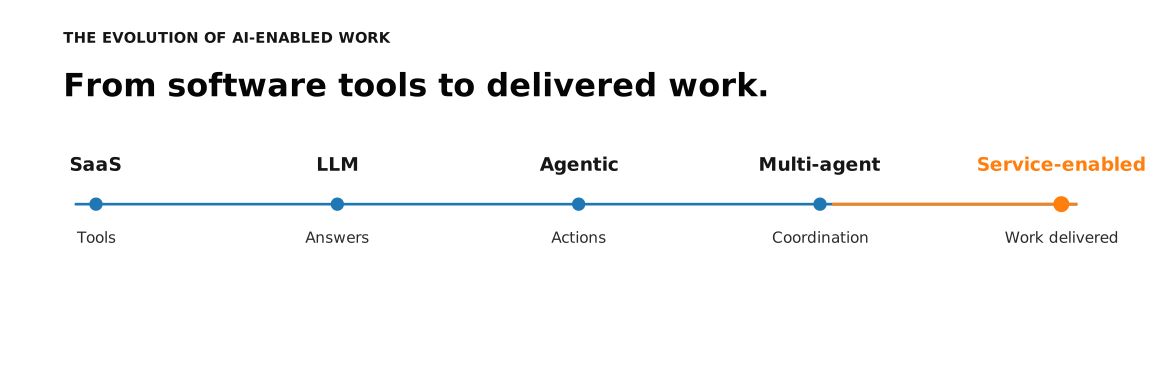
From tools and answers to coordinating agents and delivering the work.
5. The models enable the change; the knowledge graph, agents and learning loop make it work
So why not just give your scientists ChatGPT or Claude, or use the AI platform
your company already has? It is a fair question. I use these models every day,
and their progress has been remarkable. But a retail AI service on its own is
not the system I have been describing.
A model can only work with the information it can reach, within the limits of
its attention and the way the task is framed. In pharma, much of the difficulty
lies in knowing what you have not found: the same compound has several names, an
asset has changed hands, a result appeared first at a conference, a trial
amendment has disappeared behind the current record. Larger context windows
help, of course. They do not organize all of this information for you.
AI is very good at molding the work to the question the client has. But to mold
something you need a skeleton. Otherwise you get goo. That skeleton is not
another clever prompt.
This is why we have spent years building a biomedical knowledge graph, now with
more than 10 billion nodes and 25 billion edges, integrating over 100 curated
sources with normalized entities and provenance. But the graph alone is not the
answer either. Complex work products have many interdependent questions that
must be investigated independently and then put back together without
contradictions.
We therefore bring together dozens of specialized agents, the graph, and our
scientists in a coordinated workflow. The agents perform and reconcile the
information work. Scientists establish the methods, direct the investigation,
and challenge the conclusions. Clients bring their own context, react to the
findings and ask new questions. We capture those decisions and use them to
improve the methods and the next round of work. That learning loop matters as
much as the individual agents.
We also tested the difference in practice. In March 2026, we evaluated a target
product profile for Crohn’s disease alongside output from another large
pharmaceutical company’s internal AI platform and a frontier-model system. Our
analysis included a calculated current efficacy baseline and a more extensive,
traceable set of references; neither comparison output provided the baseline.
This was one particular exercise, assessed by our own team, not a ranking of the
models. The internal system had strengths of its own. But it is a good
illustration of why having a very capable model is not equivalent to having a
complete scientific analysis.
Some of the engineering we built in the early days existed only because the
models were not very good. We expect that layer to become less important, and
frankly we are happy when it does. We are model-agnostic: if a better model
becomes available tomorrow, we want to use it. What takes much longer to
reproduce is the organized evidence, the historical record, the methods and the
process by which scientists and clients keep improving the work.
Toward the end of 2024, we started reorganizing how we delivered our services
around this approach. Our partnership with
[ClearView Healthcare Partners](https://clearviewhcp.com/clearview-healthcare-partners-announces-strategic-investment/),
which began then and was publicly announced in January 2025, gave us the
opportunity to test and refine the model through actual projects. Others,
including [Bessemer](https://www.bvp.com/atlas/state-of-health-tech-2024), were
articulating a similar vision for AI-powered services around the same time. For
us, the work of making it real was already under way.
The result is something companies can buy as a service, with the customization
and scientific attention they expect from consulting, rather than spending years
building all the machinery themselves. And there is a natural opportunity for
existing consultancies and frontier AI developers to combine their strengths
with an established, specialized capability.
6. Pharma and frontier labs are investing in AI, but strategic decisions are a different problem
Pharma has already started putting serious money behind AI. BioNTech acquired
[InstaDeep](https://instadeep.com/2023/07/biontech-completes-acquisition-of-instadeep/)
in 2023 after years of working together, to strengthen its ability to discover
and design medicines using AI. Merck’s April 2026
[partnership with Google Cloud](https://www.merck.com/news/merck-and-google-cloud-partner-to-accelerate-agentic-ai-enterprise-transformation/),
valued at up to $1 billion, is broader: R&D, manufacturing, commercial work and
other company operations. These are not just companies buying more chatbot
seats.
And I think what the frontier AI companies are doing is perhaps even more
telling. OpenAI
[agreed to acquire Tomoro](https://openai.com/index/openai-launches-the-deployment-company/)
in May to bring in people with experience deploying AI inside other businesses.
That same month, an AI services company backed by Anthropic and investors
including Blackstone
[acquired Fractional AI](https://www.blackstone.com/news/press/the-ai-native-enterprise-services-firm-backed-by-anthropic-blackstone-and-hellman-friedman-announces-acquisition-of-fractional-ai/)
for its engineering and delivery expertise. Anthropic has also been developing
[Claude Science](https://www.anthropic.com/news/claude-science-ai-workbench) for
research. It seems even the companies building the models understand that the
technology alone does not make the work happen.
Then, on October 20,
[OpenAI acquired Orchestra Bio](https://openai.com/index/openai-to-acquire-orchestra-bio/),
whose technology helps scientists and program leaders coordinate the work of
drug development, and is bringing it together with Rosalind, its tools for life
sciences research. I find this particularly interesting because it is about the
rather messy reality of getting a drug through development, rather than
improving a model’s ability to answer a biology question.
But there is a distinction worth making. Finding a target, understanding biology
and designing a new molecule is scientific discovery. Coordinating studies and
programs so that a candidate advances is drug-development execution. Deciding
which candidate deserves investment, which indication to pursue, what a drug
must achieve to be successful, or which white spaces are worth exploring is
strategy and intelligence. Of course they overlap. But they involve different
evidence and different questions. Much of that last category is still performed
by consultants and intelligence teams, and it is precisely where we have
concentrated our work.
I think we are only at the beginning. If AI lets us discover more candidates
faster, what happens next? More assets to evaluate, more potential indications,
more changing competition, and decisions that still have to be made on time. It
would be strange to invest so heavily in discovery and in AI deployment, and
then leave the decisions about what to develop on the old calendar. That is the
opportunity I find most interesting.
Conclusion: The question is what companies can now afford to investigate
I do not think every analysis will be better simply because it uses AI. There
will be plenty of fast, inexpensive, incomplete work. What matters is whether
the intelligence helps a team explore possibilities it might otherwise have
missed, and arrive at an answer that can withstand scrutiny while there is
still time to use it.
That requires changes on both sides. Those delivering intelligence must put
together the models, the data, specialized technology and scientists who can
stand behind the conclusions. Those commissioning it should leave room for the
question that emerges once the first answer is understood. Otherwise we may
have spent an extraordinary amount of money making the old process faster.
The question I would leave pharma executives with is simple: which
investigations are you not doing today because they would take too long or cost
too much? And what would happen if you could finally do them, and keep the
answers current?
---
Source note: The delivery improvements and anonymized customer example describe Epistemic AI’s experience. The March 2026 TPP comparison was run and scored by Epistemic AI; the large-pharma internal-system output was evaluated from its own demonstration. It was a qualitative comparison of a specific exercise, not an independent benchmark or a claim about current frontier-model rankings. Customer identities and clinical specifics are omitted.